This is my September 2026 #Emacs Carnival entry.
Back in the mists of time, there was Zippy the Pinhead. For a while, zippy quotes were included as part of emacs, but they were not free, so they were removed.
Here, to help you “understand” Zippy are a couple of the comic strips Zippy OneZippy Two, but “understand” is the exactly the wrong word when it comes to Zippy.
Now, add to that even less context. Just the text of random zippy quotes and you’ve got … well, you tell me what you’ve got?
The last thing that happens in my emacs startup config displays a random Zippy quote on the status line. Here’s the code.
This is my emacs carnival blog post for January 2026
responding to Christian Tietze’s prompt “This year I’ll…”
This year emacs-related goals include moving into denote, updating workflows, integrating AI where it makes sense and sharing more publicly. Specific packages will include denote, gptel, and likely something with Claude code. Still loving org-social.
This is the year of the verb: “to emacs”.
This is my September 2026 #Emacs Carnival entry.
Back in the mists of time, there was Zippy the Pinhead. For a while, zippy quotes were included as part of emacs, but they were not free, so they were removed.
Here, to help you “understand” Zippy are a couple of the comic strips Zippy OneZippy Two, but “understand” is the exactly the wrong word when it comes to Zippy.
Now, add to that even less context. Just the text of random zippy quotes and you’ve got … well, you tell me what you’ve got?
The last thing that happens in my emacs startup config displays a random Zippy quote on the status line. Here’s the code.
In the beginning, there was TECO1.
And darkness was on the face of the programmers,
And the MIT hackers said “Let there be Emacs”,
And there was a collection of TECO maros".
This is the first in what is planned to be a series of posts on “The people of Emacs”
who have influenced me. I’ve found that the use of Emacs is often a marker for “interesting
people doing interesting things”. I have absolutely zero interest in tracking weight
lifting stats, but using Emacs on Android as a base for “replacing
proprietary software with free alternatives”? Now I’m listening.
1 Emacs Carnival, December 2025 - “The People of Emacs”
This is a writing prompt for Emacs Carnival for December 2025.
The basic ask is to write about “Emacs people you’ve known.” Preference is given to people who influenced you, who inspired you, who taught you, or who bent your mind. Bonus points if they are people you’ve known in “real life” (offline). Of course, stories, character sketches, tributes and poetry are encouraged.
I recently faced frustration while trying to get clarity on my insurance coverage. I discovered a solution that spares me from time on hold. It also holds promise for freeing people stuck answering calls to pursue more fulfilling work. I used AI in ways the company never envisioned.
In ancient Rome, there was a temple to the god Janus (he of the month “JANUary” fame).
There was a tradition that the gates of the temple of Janus were to be
closed in times of peace, and open in times of war. They were
usually open.
I asked the Brave web browswer’s AI-assisted “Leo” search engine and
ChatGPT to put that in in cotext, both in the history of Rome and in
the past 150 years of world history.
If ancient roman rules applied world-wide, when would the gates of janus be closed?
I also added some commentary what motivates the credit unions (and it’s not
your security and privacy) and the sad state of things 9 years after
one of them lost 200 million records (likely including yours).
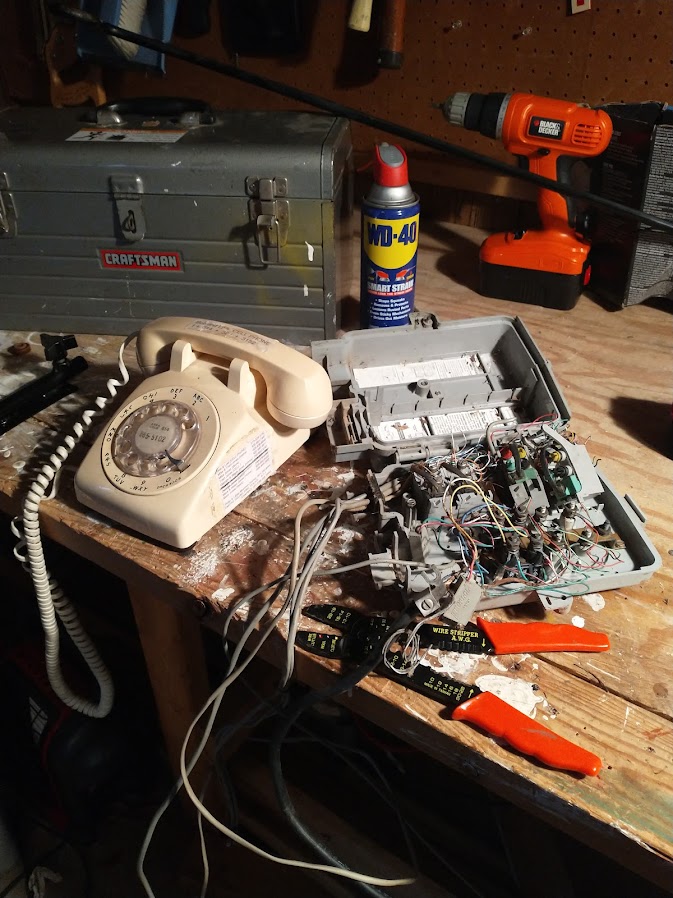
Today was the day I removed the TNI (Telephone Network Interface) from
my house. The last vestiges of our land line. The last outpost of a
once vast network.
Figure 1: “This Phone Is Property of Ohio Bell” by George Jones is licensed under CC BY 2.0